
AI Volatility Market Update
The Nasdaq ended the week of 11/16/2026 down 8.0% while the S&P 500 drawdown reached 6.8%. Within stocks, technology was hit the hardest, down 9.6%, while consumer staples were up 0.42%. The decline has been fast, concentrated, and emotionally charged – reinforced by a series of headlines that read like a pulp fiction novel and lowered investor confidence in AI.
Trailing One-Week Total Returns Pulled Back Sharply Across Most Sectors
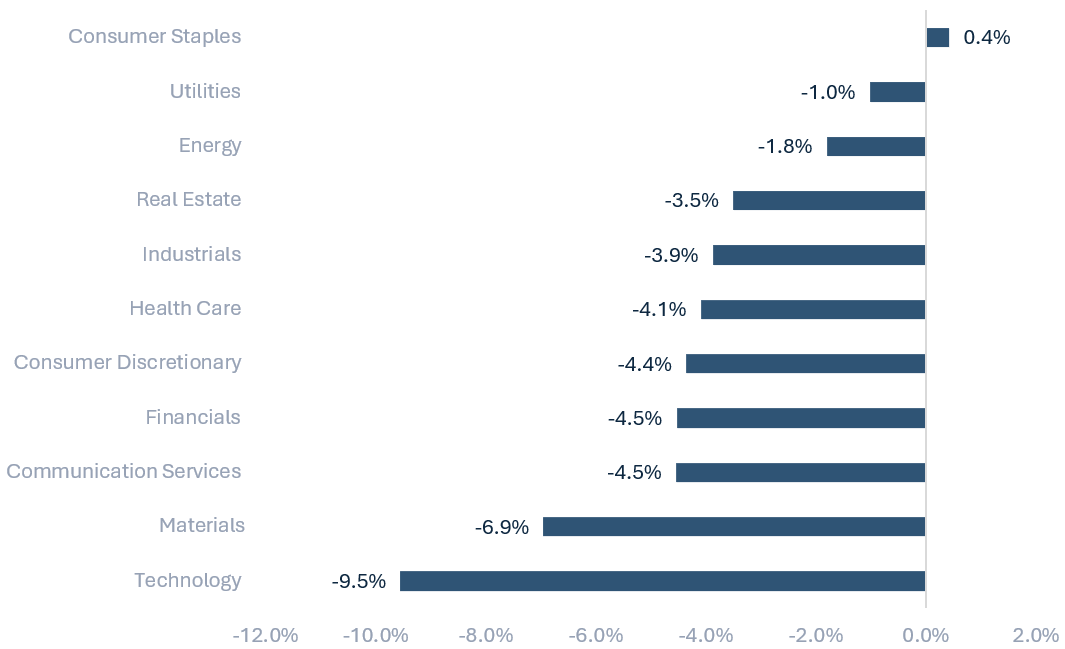
Source: Morningstar Direct. Sector returns represented by Select Sector SPDR ETFs: Consumer Staples: XLP, Utilities: XLU, Energy: XLE, Real Estate: XLRE, Industrials: XLI, Health Care: XLV, Consumer Discretionary: XLY, Financials: XLF, Communication Services: XLC, Materials: XLB, Information Technology: XLK. Trailing 1-week total return as a percent. Data as of 11/20/2026. Past performance is not indicative of future results.
So, what happened? The popular answer is the AI trade broke. The nerdy answer, which is our answer, is that AI economics is evolving from model performance and adoption to include traditional economic metrics like return on invested capital. The price investors are willing to pay before they see durable revenue, positive operating cash flow net of capex, and acceptable returns on capital changed.
What’s next for the AI trade?
Q3’s earnings season brought to light the importance of return on invested capital for the hyperscalers’ AI buildout. A commonly used metric to evaluate the profitability of a company is free cash flow, which subtracts capital expenditures from operating cash flow. Free cash flow turned negative in Q2 and Q3 for many hyperscalers as AI companies spent more cash than they took in and used debt to finance the intensive capex spent on the AI buildout. Investors are naturally concerned. For instance, Google saw its second straight quarter of negative free cash flow and its stock experienced its largest single day decline since it went public – roughly 12.6% on 10/29/2026. Add to the mix the SEC’s investigation into Nvidia’s accounting practices and Anthropic’ s record IPO of more than $100 billion, and there are the ingredients for a major market pullback.
Hyperscalers’ Capex and Free Cash Flow
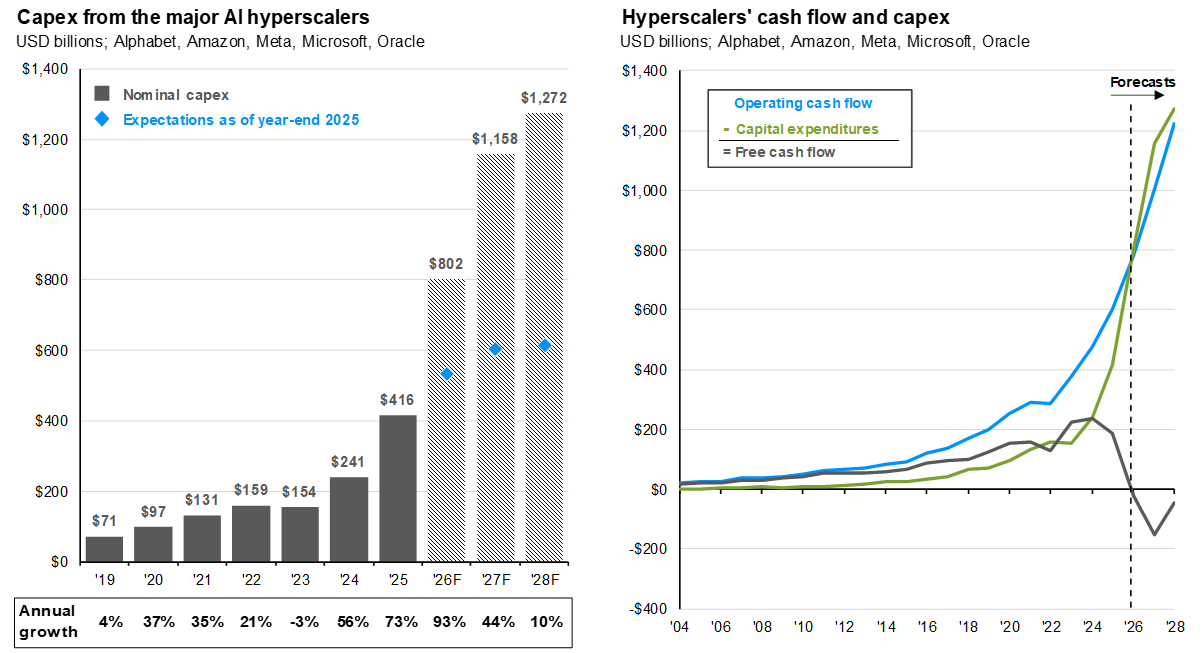
Source: Bloomberg, J.P. Morgan Asset Management. Data for 2026, 2027 and 2028 reflect consensus estimates. Capex shown is company total. Hyperscalers are the large cloud computing companies that own and operate data centers with horizontally linked servers that, along with cooling and data storage capabilities, enable them to house and operate AI workloads. Guide to the Markets – U.S. Data are as of November 20, 2026.
These are legitimate problems that the AI industry will have to work through; yet we do not think this spells the end for AI as an investment theme. Investors are finally asking: who pays, who earns, and who carries the risk? We are moving from AI enthusiasm to AI economics. Adoption and model performance still matter, but adoption and performance alone is no longer enough. Traditional business economics is now coming into sight: pricing power, margins, financing needs, security, reliability, and return on invested capital now sit beside model performance and adoption as the measures that matter.
Corrections are normal when expectations, positioning, and capital needs become extreme. Hyperscalers and neoclouds are in extreme competition for financing of land, power, and shell – all while capital isn’t cheap. Companies with strong balance sheets, that show AI revenue is durable, have economics improve with scale, and have capex spending that produce acceptable returns will be rewarded. There’s a difference between AI used to widen margins or deepen customer relationships and AI used for the sake of the story with no material improvements in the business.
We see an evolution in leadership in the AI trade. Chips, data centers, power, and cloud capacity remain essential, but more value should migrate toward the application layer and the systems that make agents safe and useful: vertical software, cybersecurity, identity, data quality, observability, payments, and workflow orchestration. Again, the market is not deciding whether AI works – it’s deciding who will profit from it and at what price.
Where does this leave markets and portfolios?
We expect leadership to broaden within the stock market. Over the last one month as tech stocks have pulled back, concentration risk has improved a few percentage points, and traditionally defensive sectors like consumer staples, utilities, and healthcare have outperformed.
Trailing One-Month Total Returns Show Defensive Sectors Leading
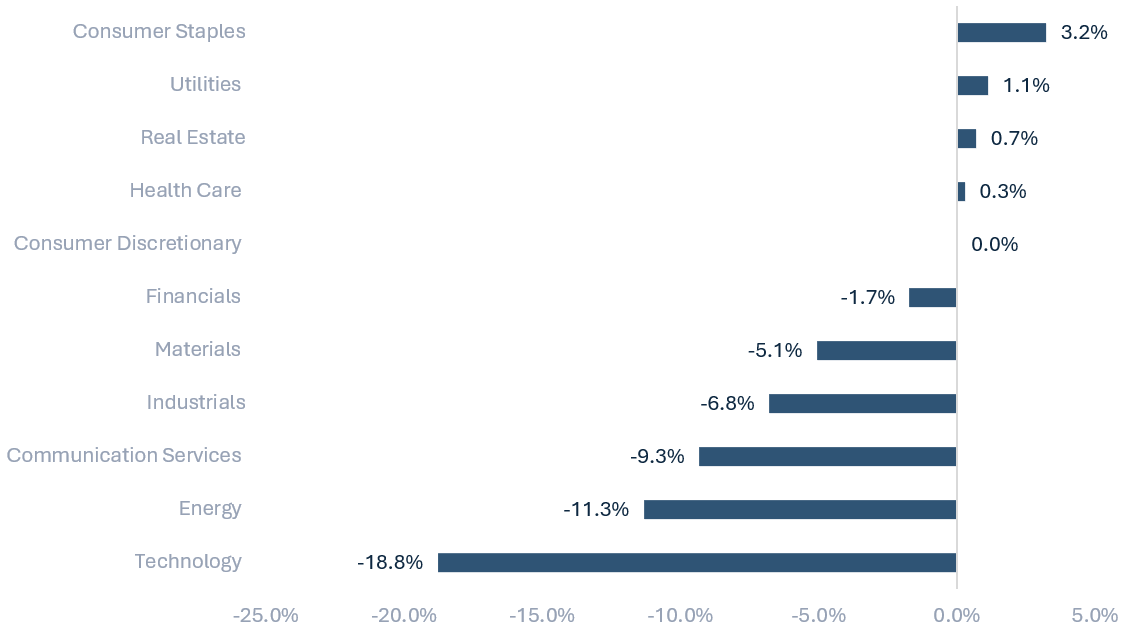
Source: Morningstar Direct. Sector returns represented by Select Sector SPDR ETFs: Consumer Staples: XLP, Utilities: XLU, Energy: XLE, Real Estate: XLRE, Industrials: XLI, Health Care: XLV, Consumer Discretionary: XLY, Financials: XLF, Communication Services: XLC, Materials: XLB, Information Technology: XLK. Trailing 1-month total return as a percent. Data as of 11/23/2026. Past performance is not indicative of future results.
Taking stock of year-to-date performance: the recent pullback in stocks was extreme, but many areas are still up for 2026. Large cap stocks (S&P 500 Index) are still up 6.7%, small cap stocks (Russell 2000 Index) are up 8.7%, international developed stocks (MSCI EAFE Index) are up 4.5%, emerging market stocks (MSCI Emerging Market Index) are up 6.2%, and bonds (Aggregate Bond Index) are flat.
Major Asset Class Total Returns Year-to-Date
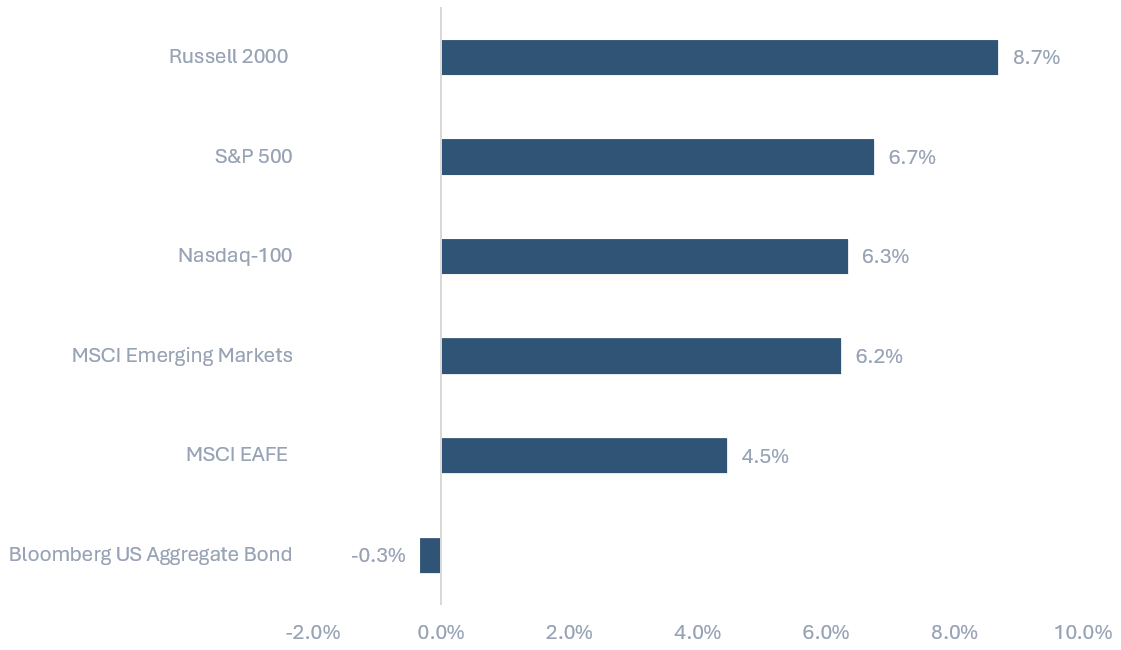
Source: Morningstar Direct. ETF proxies: iShares Russell 2000 ETF (IWM) for small cap stocks, State Street SPDR S&P 500 ETF (SPY) for large cap stocks, Invesco QQQ Trust (QQQ) for the Nasdaq, iShares MSCI Emerging Market ETF (EEM) for emerging market stocks, iShares MSCI EAFE ETF (EFA) for international stocks, and iShares Core US Aggregate Bond ETF (AGG) for bonds. Indexes cannot be invested in directly. Trailing year-to-date total returns. Data as of 11/23/2026. Past performance is not indicative of future results.
Our portfolio posture is constructive, but disciplined. We are diversified across stocks and asset classes depending on risk profile and prefer to keep exposures to riskier areas of the market smaller and prudent. We have exposure to domestic stocks across the cap spectrum, hold international developed stocks, and a small amount of emerging market equities. Small cap stocks and international developed have generally held up better than large cap in this pullback due to the lower exposure to tech.
For those where it’s appropriate based on risk tolerance, we also hold high-quality bonds with an emphasis on Treasuries, municipal bonds, mortgage-backed securities, and high-quality corporate bonds. We tend to prefer the shorter end of the yield curve to decrease price swings from interest rates.
A bull market doesn’t die of old age or from one individual stock; a bear market tends to occur from expectations for lower forward earnings and/or recession concerns. Although anything is technically possible, a bear market in the S&P 500 isn’t our base case over the next three months.
What is in our base case is elevated volatility. Even in the two business days it took to write and send this article through compliance, the return spread between Friday’s (11/20/2026) low and Monday’s (11/23/2026) rebound is nearly 8%. This highlights the perils of market timing, which is not a good long-term strategy. Instead, use this as a time to rebalance and invest any excess cash, not react.
Advus Financial Partners, LLC is an investment advisory firm registered with the Securities and Exchange Commission (“SEC”) under the Investment Advisers Act of 1940. SEC registration does not constitute an endorsement of the firm by the SEC, nor does it indicate that the adviser or investment adviser representative has attained a particular level of skill or ability. The oral and written communications of an adviser provide you with information about which you determine to hire or retain an adviser. For more information please visit: https://adviserinfo.sec.gov and search for our firm name. This commentary has been provided for informational purposes only and is not intended as legal, tax, or investment advice, or as a recommendation of any particular security or strategy. The investment strategy and themes discussed herein may be unsuitable for investors depending on their specific investment objectives and financial situation. Information obtained from third-party sources is believed to be reliable though its accuracy is not guaranteed. Opinions expressed in this commentary reflect subjective judgments of the author based on conditions at the time of publication and are subject to change without notice. Past performance is not indicative of future results. Bonds are subject to market, interest rate, and credit risk; and are subject to availability and market conditions. Generally, the higher the interest rate the greater the risk. Bond values will decline as interest rates rise. Government bonds are subject to federal taxes. Municipal bond interest may be subject to the alternative minimum tax; other state and local taxes may apply. High yield bonds, also known as “junk bonds,” are subject to additional risk such as increased risk of default. Some asset-backed securities may have structures that make their reaction to interest rates and other factors difficult to predict, making their prices volatile and they are subject to liquidity and valuation risk. An index is an unmanaged portfolio of specific securities, the performance of which is often used as a benchmark in judging the relative performance of certain asset classes. Investors cannot invest directly in an index. An index does not charge management fees or brokerage expenses, and no such fees or expenses were deducted from the performance shown. Forecasts, estimates, and forward-looking statements are based on current expectations and assumptions, are subject to change, and may differ materially from actual outcomes. Diversification and asset allocation do not guarantee a profit or protect against loss.